

 Prefer WhistleOut in Google
With a track record in the category that stretches all the way back to 2011, Lenovo’s pedigree for premium tablets is almost as long as that of Apple. It’d be an understatement to say that tablets have changed a lot in the time since then.
According to Lenovo’s GM for its Android device business unit Tony Chen, the category’s latest incarnation is one that leans more on the idea of versatility than any specific use case.
“Previously, it was all about entertainment. Then, the move to learning. Then, productivity. Then, creation and gaming,” he explained.
On the other side of these efforts to pitch premium tablets as the answer to the problems of those in a particular niche is a newfound emphasis on the idea that this form-factor is best positioned to follow through on the elusive dream of convergent computing: one device that does it all.
While the requirements of that ideal have shifted over the past fifteen years, Chen makes the case that the tablet has a form-factor uniquely suited to the AI era.
Speaking at this year’s Lenovo Innovation World conference in Berlin, he argued that tablets offer the most “rich interaction approaches” when it comes to interfacing with AI-powered technologies.
“We have a stylus, we have a keyboard, we have a camera, we have a microphone, we have touch, we have GPS, we have a lot of sensors. All these kinds of devices combined into one form-factor with the tablet. It’s portable, and powerful and [has] a connection to 5G, which makes these devices always connected to the cloud and AI and internet.”
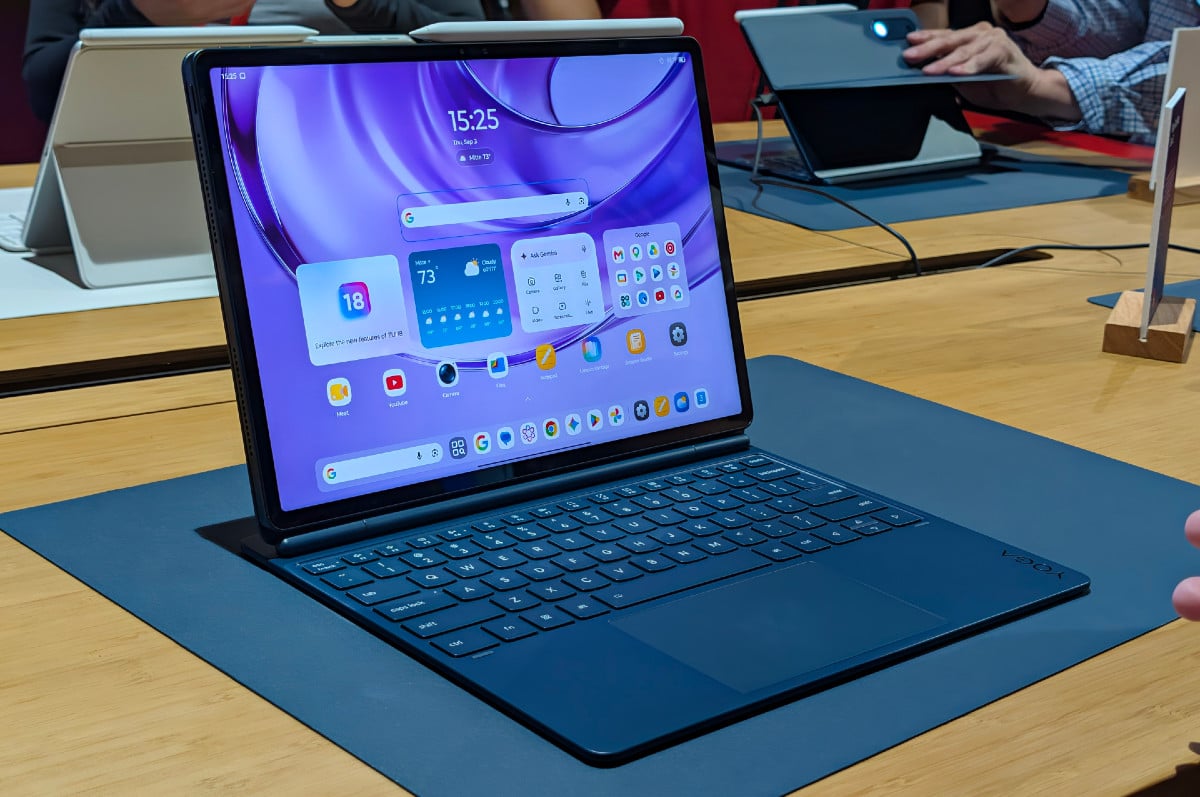
Even so, he’s happy to admit that AI isn’t quite topping the list when it comes to the concerns of consumers who opt for the high-end Lenovo tablets like those shown off at the company’s recent Innovation World showcase in Berlin.
Citing a recent survey which gathered feedback from approximately 9600 consumers, Chen said that AI experiences are becoming increasingly important to consumers – though they don’t yet top typical considerations like performance, battery life, and display quality. By comparison, Chen said that AI features typically fell within the top seven.
Intriguingly, the relative importance of AI features varies by market. Chen said that Australians’ sit somewhere in between the extremes found elsewhere.
“The ones who are eager to impress are more like China and India. They prefer to embrace AI. Some countries, such as Peru and Germany, hesitate. That’s just the ratio. It’s relative and you guys are in the middle,” he said.
This survey also revealed a number of surprising insights when it comes to how those buying Lenovo’s premium tablets feel about the cost involved.
"The younger generation have, I would say, less resistance to the pricing increase or let’s say they have a more acceptable [attitude] towards the price increases,” Chen said.
Another finding of the survey was that high-end users refreshed their product earlier than the mainstream players.
“They want to try something new, and AI motivates them to try even faster or more powerful tablets,” he said.
When it comes to competing with the biggest name in premium tablets, Chen said that Lenovo can’t just rely on cheaper pricing to generate demand. Regardless of whether it’s looking to leech new customers from the iOS ecosystem or convince existing ones to upgrade to the latest model, it has to work harder to show the value of doing so.
Looking back on the past fifteen years of tablets, Chen also noted the role of 5G connectivity and eSIM.
“On the consumer side, if you want to connect to the latest AI then you should make sure that your tablet or your device is always online.”
“eSIM, is getting more and more popular in the last one or two years. That’s why when people use a tablet and they can connect to AI, they don’t want to open the hotspot [on their] smartphone to connect [their] tablet to the internet.”
“If you want to access AI, tablets should be the best form-factor. That’s my thinking,” Chen said.
Disclosure - the author of this piece travelled to IFA 2026 as a guest of Lenovo.
Fergus Halliday
Digital Content Editor


